Chip Cycles & Book Notes From Chip War
First time a book misprinted and I lost a chapter of content, never has this happened to me before lol.


Introduction
Semiconductor has been booming for the past 5 years. Semiconductors are in demand and sales are going through the roof; what usually follows are stock prices shooting straight up, and now that I’m a bit more conscious, I’d like to take advantage of the situation that we’re in before it all crashes (or not). By serendipity, I’ve reading the Chip War by Chris Miller, which talks about the semiconductor industry and how each company operates, free due diligence!
I started the book ~4 months ago (January), promising myself to just read 1 page a day (most days 1 page turns into 1 chapter), but stopped for sometime. Though, recently after I realized every company that I was reading about was up ~100-400% since the book was published, I’ve locked in and have hunkered down, reading about 20-30 pages a day to finish it.
Without further to do, let’s go over some notes that I’ve taken on the book! First starting off with notes I’ve learned about the semiconductor cycle industry recently. Now the notes are juggled around, but they will be labeled accordingly.
Table of content
Introduction & semiconductor cycles
Semiconductor & software industry intertwines
Cycles in niche semiconductors
Disruption to the cycle
Notes from Chip War
wtfis (terms)
Web3 vs Chips
Random links to dive more into chips
Main takeaways from book & TL;DR of chip cycles
Note: I use Chips/Semiconductors interchangeably
Semiconductor cycles
A mini history of semiconductor cycles (to my best knowledge). Not from Chip War btw, but I believe this is worthwhile information to look into. We’ve seen the semiconductor cycle play time and time again, such as the PC era in the 1990s, smart devices in the 2010s, more smart devices during COVID, and now crypto mining / AI in the 2020s. The chip industry has been shadowed by software in the 21st century, so it’s cool to see it finally reap the compounded work effort translated through stock prices.
Here’s a few reasons I believe why we see these chip cycles: shortages and demand in new tech industries from both the consumer and business side; supply chain war with China as they’re also racing to dominate in chip manufacturing; the Taiwan chip dilemma; and competition between the US, South Korea, and Japan.
Every device in the future will require chips; from everyday consumer items like cars, coffee machines, and laptops to business expenditures like data centers, weapons sadly, space, etc.
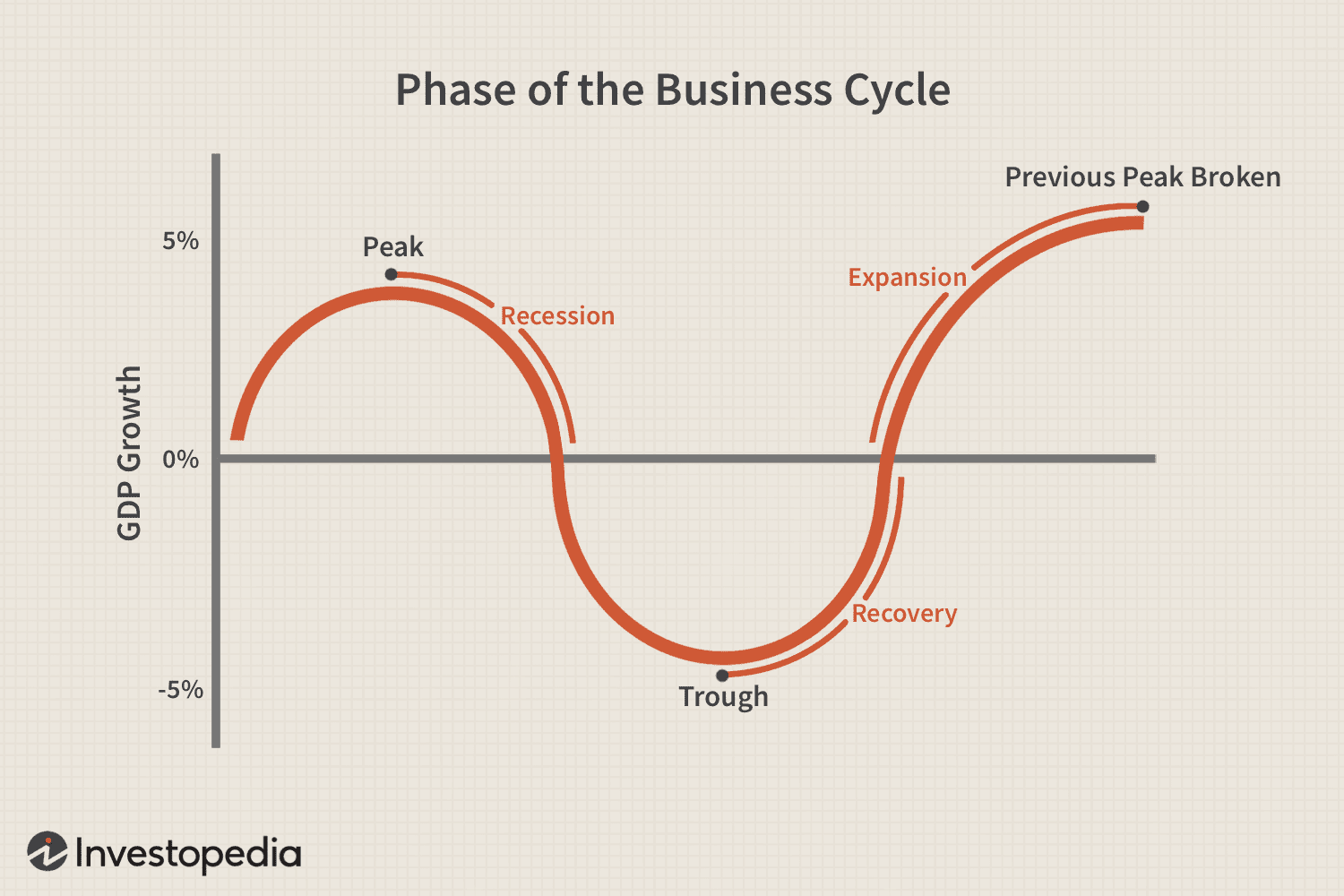
Here’s a rundown of what a semiconductor cycle looks like:
Expansion Phase: Surge of demand from new tech (ex: PCs, smart phones, electric vehicles, AI) drives up prices. Leads to a call for more production and investments in new fabrication plants aka “fabs” or “foundry” to keep up with demand.
Peak: Fabs are built out, and hype for this new tech is at peak while manufacturers are running at full capacity to make more and more chips. The Euphoria phase.
Slowdown Phase: Hype slows down, either missed earnings, economic downturns, a saturation of chips in the market (too much produced), or a shift in consumer purchasing → Manufacturers are left with excess inventory of chips. Prices, investments, and stocks decline.
Trough: Companies fully scale back on investments. Stock prices plunge and go back to actual normal levels.
Semiconductor & software industry intertwines
When a new software applications is hyped up (cloud computing and AI), hardware trails the hype. New software = better chips needed. Chips often take 24-36 months to make, from design decisions to chip production. Therefore, when a software cycle peaks, the hardware infrastructure hasn’t actually caught up yet, leading to an imbalance in supply and demand. Which causes prices to shoot up as there’s a shortage of new chips.
Cycles in niche semiconductors
Lurking around in an investing discord, I read from Charan Dangeti (@charan.invests) that semiconductors follow a cycle, and the niches inside the chips industry also have their own cycles… So I decided to look into it.
Memory chips (DRAM & NAND): Highly cyclical; demand is directly tied to data storage needs, which most recently has been AI training and data servers. In the past (and now) it has been smart devices and phones. When these products slow down in need of memory, memory prices then plummet.
Analog chips: Used in a wide range of products. Demand fluctuates with the broader economy & trends.
Logic chips: Certain logic chips can be affected by cyclical patterns based on the specific industry they’re needed in (e.g., automotive electronics, PCs, AI training).

An article by UncoverAlpha notes that the cycle we’re in right now is different compared to the past. The reason being all past cycles were because of physical demand that was only bought once and that was that, ex: smartphones and PCs. Whereas in this cycle, memory chips will be an everlasting product for AI. Since AI cannot operate without high processing chips and memory chips, their conversations with humans will always be expanding. While I do agree with this take, I also believe UncoverAlpha missed a key point on whether AI companies will perform well. Because if AI is returning a profit, then companies will scale back on AI investments, leading to less chips being purchased.
Uber COO recently said there was no real linkage between using AI and productivity gain (which imo disagree). — Cointelegraph
Disruption to the cycle
”A demand-driven boom lasting 4-7 quarters, followed by an oversupply-driven bust lasting 4-8 quarters, with revenue declines of 25-40%, margin compression from peak levels above 50% to the low 20s or even negative, and stock price declines of 50-60% that lead the fundamental downturn by 1-2 quarters.”
— https://www.uncoveralpha.com/p/every-memory-cycle-ends-the-same
This cycle arguably started in Q4 2022 when ChatGPT was released, or Q3 2023 when Nvidia released H100 chips according to others. And as of Q2 2026, it means that 10-14 quarters has already passed compared to regular chip cycles lasting 3-5 years (12-20 quarters).
Forecasts expected a downturn mid-2026, though these dates have pushed back; and Goldman Sachs says the current DRAM shortage could last until 2027. Philadelphia Semiconductor Index is also at all time highs, growing significantly fast and similar to 2002 trends. Some indications already show that billing of semiconductor growth has slowed down.[9] Following the cycle quoted from above, we would have at most 6 quarters before stock prices start plunging.
Though UncoverAlpha also says that this decline cycle won’t last as long:
“DRAM prices will inevitably decline 20-30%”
"During the trough phase: “15-25% revenue decline and margins compressing to the 35-40% range, rather than the historic 30-40% revenue declines and sub-25% margins of previous busts.”
Track hyperscaler capex guidance and supply chain inventory levels to get a better understanding of where we are in the cycle. When hyperscalers start trimming AI infrastructure budgets, that’s your earliest warning the cycle is turning.
The same has been said here about disruption to the cycle:
"The best use of WSTS data has been to follow the semiconductor cycle. Driven by the two-year investment cycle of semiconductor companies and the boom-bust memory pricing, the Semiconductor market has followed a 4-year cycle of a few quarters’ sharp downturn and a longer climb to the next peak.
Not even the dot-com crash, COVID, or the financial crisis has managed to disrupt the cycle. That is up until now.”
I recommend you to read this article as it has a nice perspective on chip cycles and patterns: https://www.uncoveralpha.com/p/every-memory-cycle-ends-the-same and https://clausaasholm.substack.com/p/the-semiconductor-industry-overview
That’s enough of me rambling, here’s a few things that I learned from the book
Notes I took throughout reading the book:
Humans are slow
In the early days of computers, we started with vacuum tubes for operating binary outputs. Though this turned out to be only for niche sectors because there were a lot of issues with this approach, it being too big, having too many bugs, breaking down every 2 days, etc. We realized in the beginning that humans are slow and it takes a lot of us to do tasks that computers can do very quickly and more efficiently.
Innovating > Copying
Even though the USSR had amazing and brilliant physicists, they were ingrained in copying US chips rather than focusing on innovation and improvement. This led to a huge lag in their development of chips and ultimately allowed the US to widen the gap in chipmaking between both countries. It’s also noted that great physicists in Russia were highly secretive, meaning many people had no idea what was going on behind the scenes. College students weren’t studying electrical engineering or idolizing great physicists because they didn’t know they existed, which led to fewer college students studying physics and chips.
Visionary Morita
Morita envisioned a future of chips powering the world before everyone else and before any device had them. It’s inspiring and makes me wonder how Morita was able to predict this.
“Our plan is to lead the public with new products rather than ask them what kind of products they want.” Morita declared, “The public does not know what is possible, but we do…” (pg. 48) This reminds me of the quote from Henry Ford about how if he had asked the public what they wanted, the public would’ve said to add more horses. Instead, Ford saw the future as something else and stuck with it.
Lesson on when to buy chips
“The chips industry had many downturns, and Japan was very dominant during these times. When commodities are low in price and people are in liquidations, it’s usually the best time to buy.”
“Didn’t want to take the margin hit”
Apple was looking for a partner for their IPhone chips, and they reached out to Intel but were rejected because the Intel CEO didn’t see the vision. Huge fumble because he later admitted he didn’t want to mess with profits and balance sheet numbers in the short term (pg. 191).
“Transistor Girls”
A big reason why we are advanced to where we are today is because of the “Transistor Girls,” who worked cheaply making chips, fueling the chip industry and growing the economy. US vs Soviet -> Japan
Conway glaze quote
“Conway was a brilliant computer scientist, but anyone who spoke with her discovered a mind that glistened with insights from diverse fields, astronomy, to anthropology to historical philosophy. She had arrived at Xerox in 1973 in “stealth mode,” she explained, following being fired from IBM in 1968 after undergoing a gender transition.”
TSMC > Samsung
Companies didn’t want to rely on Samsung for producing their chips because they were afraid Samsung would take their chip secrets for their own products. TSMC, on the other hand, has a whole business model that is to build chips for other companies; therefore, companies weren’t afraid to partner with TSMC. The same can be applied to AMD about not wanting to reveal trade secrets.
Apple and Huawei would not be able to exist without TSMC, as they are the #1 and #2 customers.
Business practices
Paranoia Wins:
Andy Grove’s paranoia strategy
Morris Chang studied Stalingrad, WW2’s bloodiest battle, for lessons on business.
Frugality & determination, Micron
Saving on costs helped Micron become what it is today. They also adopted the mindset of either producing DRAM or bankruptcy. They focused intensely on producing super cheap DRAM chips. In-house production and cutting costs. Pretty similar to how Elon operates.
Telecom, Cell networks (pg 227)
Relies heavily on semiconductors
Mobile networking standards:
1s and 0s flying via cell phone radio waves; modem chip manages phone connections to cell towers and radio waves are transmitted via phone’s antenna. The space for radio waves are limited, meaning most data in spectrum space must be packed into a semiconductor.
Each upgrade requires new hardware on phones and cell towers
2G allowed phones to send pictures
3G allowed phones to open websites
4G allowed phones to stream video almost anywhere
5G allows more transmission of data; beamforming
Monopolies:
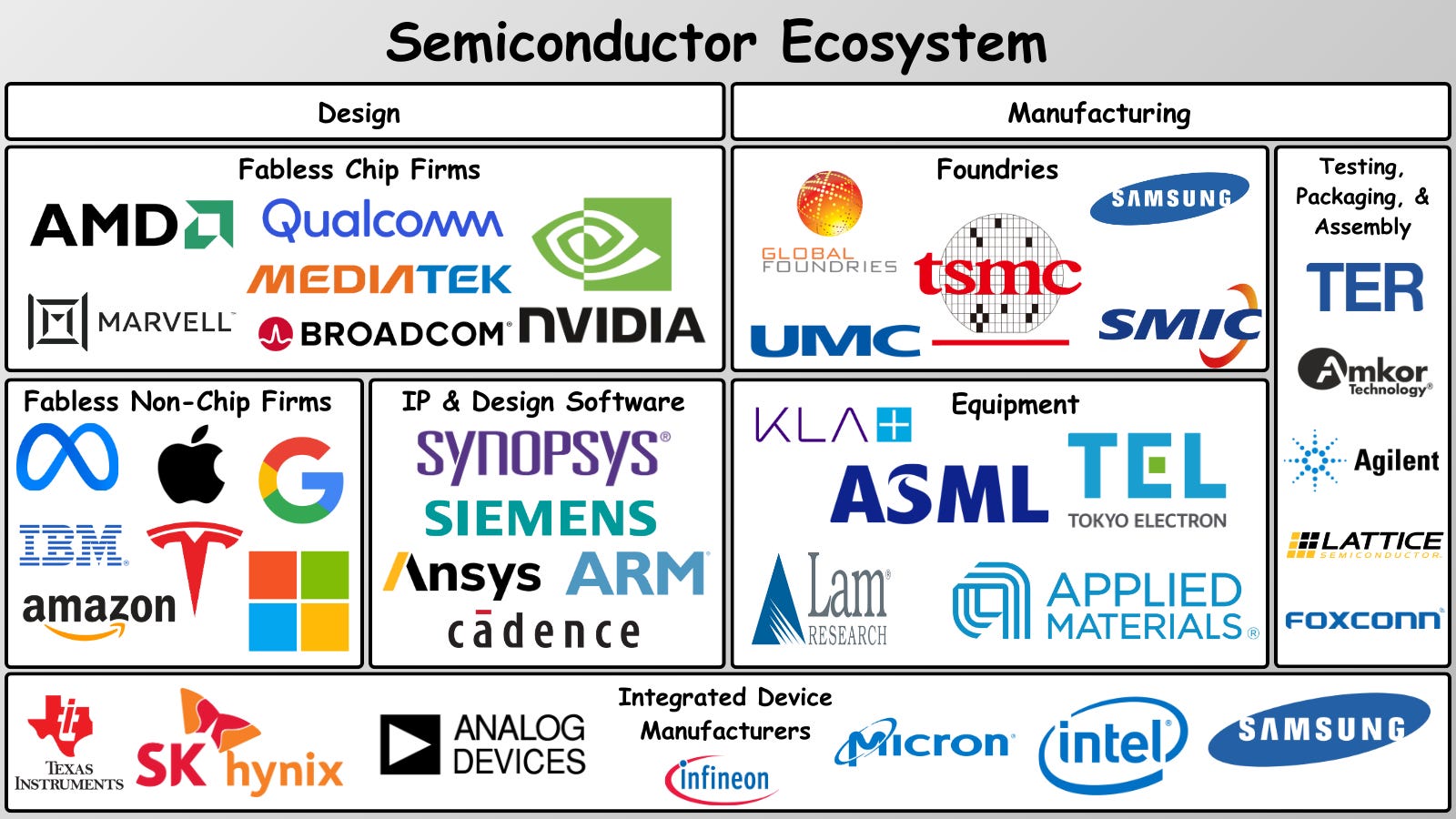
CPU:
Intel: monopoly on x86 chips which runs window PCs & data servers
AMD: produces CPUs, GPUs, and etc. Same thing as Intel
Design and fabricate chips
TSMC: Designing chips; Has trust
Samsung: Design chips; Has a bunch of other products
Nvidia: GPUs
Micron: Produces DRAM; 1 of 3 companies that produce this at scale, Samsung and SK Hynix
Advanced Processors:
ASML: Make EUV Lithography machines.
Manufacturing:
Applied Materials: biggest in chip manufacturing
Lam Research: Leader in lithography
KLA: Dominant in process control
Software for designing chips:
Cadence
Synopsys
Siemens
US needs trusted foundries
Dilemma in outsourcing logic chips. Needed trust that the chip was made the way it was intended without any tampering. Though unintended vulnerabilities are imminent such as the 2018 Meltdown.
DARPA betting on “zero trust” tech. Tiny sensors implanted on a chip to detect efforts to modifying it. (pg 290)
Could see blockchain being used.
US chips relies on China (pg 301)
Many companies like Intel, Qualcomm, and Applied Materials rely on China, “Our number one customer is our number one competitor”
x86 (PCs and servers), Arm (mobile), and RiSC-V (open source)
GPUs are heavily needed, memory pairs with GPU
Benefits companies like ASML, TSMC
GPUs need to be paired with high-bandwidth memory chips pioneered by SK Hynix
Big tech companies also want to design their own chips benefitting Broadcomm and Marvell.
NAND Chips
Used in Smartphones to USB memory sticks
5 companies dominate this
China is most suited to achieve world class manufacturing capabilities
YMTC (Yangtze Memory technologies corportation)
SMIC narrowing the gap: “Everyone knows that if SMIC had been allowed to buy EUV lithography tools and other cutting edge equipment, it would’ve narrowwd the gap with TSMC significantly” (page 368)
Breakdown of the book written by someone else (pretty helpful):
https://www.karthikchidambaram.com/chip-war-by-chris-miller-book-summary/
wtfis:
Dynamic Random Access Memory (DRAM): Two main types of memory chips using to store data temporarily.
Integrated Circuits: Microchip, includes transistors, resistors, capacitors. Thin piece of flat semiconductor material (commonly silicon)
Extreme Ultraviolet Lithography (EUV): A type of photolithography, uses light from lasers to create intricate details on a semiconductor.
Fab/Foundry: An factory for making advanced electronics, mostly known as a semiconductor fabrication plant. Also for designing circuits.
FinFet: A 3D transistor structure that allowed better control over transistor operations as transistors’ sizes shrank to nanometers.
Transistor: A piece of item that acts like a switch for moving electricity. Blocks the flow of a circuit. Has 3 things sticking out. One of them is a control pin that controls the flow of electric signals. Control pin is activated by a signal (anything that sends enough voltage and current).
Wafer: Thin slice of semiconductor material
Moore’s law: Packing more transistors into chips
Spectrum: Frequency or wavelength values. Any type of waves: sound waves, sea waves, etc.
Not mentioned in the book:
HBM (High Bandwidth Memory): Created by SK Hynix and adopted by AMD and Samsung.
Synchronous dynamic random-access memory (SDRAM): Type of memory chip
Web3 vs Chips
In the beginning of the book, I wanted to compare industries and learn how they grow. And so I also took notes on the similarities and differences I found between chips and web3.
Simplification and mass scaling
Chips: Transistors could only replace vacuum tubes (the current system) if it could be simplified and sold at scale. (pg 13)
Web3: Gas fees needs to be cheaper, and user experience needs to be simplified.
Dates
Chips: 1947 invention of the switch, 1955 Shockley Semiconductor was established.
Web3: 2008 Bitcoin, 2014 ethereum, solana 2018, hype 2024
Technology is here, but adoption is not
Chips: People agreed transistors were a clever piece of technology based on the most advanced physics, but transistors would take off only if they did something better than vacuum tubes or could be produced more cheaply. (pg. 14)
“However, Noyce’s integrated circuit cost 50x as much as a simpler device with separate components wired together. Everyone agreed Noyce’s invention was clever, even brilliant. All it needed was a market” (pg. 17)Web3: Chains are scattered everywhere; most of the tech is used for financial transactions rather than decentralizing consumer products. Central exchanges are still the most reliable and easiest to manage your money safely.
Liftoff
US companies with huge government support were looking for material that could help solve their problems, in terms of size and easiness to use.
Cutting Prices:
Noyce cut prices of chips by a bunch and even below manufacturing price because he realized how much of a market there was for customers to use. When the defense contracts proved the usage of their tech, they envisioned a future where chips were used not just for defense-related tech. They even quoted saying “relying on the military to keep your startup alive is like taking venture capital money and putting it into a savings account.” You need to take risks. Mentioned in the chapter (I WANT TO GET RICH).
Cycles
Chip purchasing and how well they were doing were cyclical and everyone knew about it.
Crypto markets are cyclical and everyone knows about it.
Being really government bonded / defense tech. Government is the first one to use it for their weapons and technology.
You see this with AI nowadays. Anthropic and OpenAI chatting with the government about taking safeguards off their models
Note: There must be a lot of government involvement with crypto in order for it to succeed.
USDT must be heavily regulated, a huge team from the US must’ve done this.
Bitcoin must’ve been a government project: though for what reason I’m not sure. Maybe to hedge against the fall of the dollar? Creating a USDC/USDT stablecoin helps cover USD debt, or at least delay it. USDT launched 2014. USDC 2018.
Random links to dive more into chips:
UBS repricing semis: https://x.com/TradexWhisperer/status/2059395381369430340?s=20
Inside a data center: https://www.youtube.com/watch?v=v477fvbj3rk
Corsair switches to AI: https://x.com/BullMarketiy9p/status/2059337072830218265?s=20
Serenity: https://x.com/aleabitoreddit/status/2059634164912226613?s=20
Commodities supercycle: https://www.heygotrade.com/en/blog/commodity-supercycle-explained/
An Overview of the Semiconductor Industry: https://www.generativevalue.com/p/an-overview-of-the-semiconductor
The Semiconductor Gigacycle: https://creativestrategies.com/research/the-semiconductor-giga-cycle/
Don’t mention the C word: Are semiconductor valuations ripe for a tumble? https://stocksdownunder.com/semiconductor-valuations/
Even the AI gold rush can’t stop the chip industry’s boom-bust cycle, warns Morningstar: https://finance.yahoo.com/news/even-ai-gold-rush-cant-154213354.html
Main Takeaways from the book
DARPA is funding the lithography industry and Zero trust tech on logic chips.
Chips are hard to make and produce. TSMC & ASML are super hard to replicate.
The current chip companies have a monopoly on the production. Chips require a bunch of components, time, and investment to be worthwhile. Which is why it’s not likely a startup competing with the current players will win, though many that do just get bought out (which could be a good thing).
“The fundamental problem with memory economics is the mismatch between demand elasticity and supply inelasticity. Building a new DRAM fab costs $15-20 billion and takes 2-3 years. Once built, the economics favor running it at maximum utilization because fixed costs are enormous.”
— https://www.uncoveralpha.com/p/every-memory-cycle-ends-the-same
China is trying to break into chips, and the US is trying its best for that not to happen through sanctions and tariffs. Any new up to date chips cannot be sold to China. Therefore, many of the chips China buys are generations behind.
China is and has been pouring billions into R&D producing their own in-house chips. Particularly in the NAND sector as it is most suited to dominate in the future (according to Chip War) through YMTC (Yangtze Memory technologies corporation). This would mean more competition in the NAND market that’s dominated by Samsung, Kioxa, SY Hynix, and Micron.
On a global scale, we’ve seen that many countries hesitant to buy from China, many even completely banning their countries from buying hardware from China mostly because of privacy concerns. Therefore, we could see the same happen towards China in chip production and not allowed to be sold globally (in my opinion, I am no expert in international trading or have supply chain knowledge).
“Beijing’s memory makers now wield growing influence over both the DRAM and NAND markets. In DRAM, ChangXin Memory Technologies (CXMT) is ramping up shipments to domestic customers, while Yangtze Memory Technologies (YMTC) is expanding its NAND output.”
— https://economy.ac/news/2025/10/202510282260
According to Omdia, CXMT’s DRAM wafer output surged from 300,000 in the first quarter of last year to 600,000 in the same period this year, and is expected to reach around 800,000 next year. Considering Micron’s quarterly DRAM wafer input of 800,000–900,000, the industry may soon need to speak of a “Big Four” rather than a “Big Three.” YMTC’s NAND output is also accelerating. From 230,000 wafers in early 2023, production exceeded 400,000 this year and is projected to hit 500,000 next year—on par with SK Hynix and Micron.
We’ve had great figures, including the working class, pioneer the chip industry and it’s because of their dedication that we are where we are today.
Web3 cycles are chip cycles are not valid to compare. Web3 is driven by hype whereas chips is driven by hype, physical assets, and growth to the economy.
TL;DR, chip cycles
If you were to takeaway anything from this article, learn how the chip cycle works; typically lasts 3-5 years (12-20 quarters).
Software/Hardware hype (AI) → Hyperscalers demand chips
Chip manufacturers invest heavily to keep up with demand → Stock prices rise
Software & Hardware hype scales back → Hyperscalers need less chips
Chip companies have an overabundant of chips with no more demand → Stock prices tank
This cycle started when ChatGPT was released in Q4 2022; we’re now in Q2 2026, meaning 14 quarters have passed. If these cycles prove to be right then the next few quarters could be rough; stay cautious and don’t full port on every hype stock.
Though, it’s been argued that one difference in this cycle is that demand has been more concentrated to a specific niche, which is AI-related, and buyers (hyperscalers) know what they want and therefore are not overspending compared to previous cycles.
To get a better understanding of where we are in this cycle, track hyperscaler capex guidance and supply chain inventory levels. When hyperscalers start trimming AI infrastructure budgets, then that can be a signal that the cycle is turning downwards. Non-AI chips (automotive, consumer electronics, analog, MCU) are apparently already in a mini down cycle. This article also only focuses on the semiconductor industry and not the broader economy. It is possible the world experiences a shock causing the stock market to dump.
Fun fact: we’ve seen people get burned over the same companies that we’re investing today that have been hyped up. Like what every investor says, “keep your emotions in check, and only invest what you’re willing to lose,” or hold long term.
I appreciate you taking the time to read this article, and hopefully this article has helped you learn just a little a bit more about the chip industry.